Leaks/seepage from the cooling system and the problem of detecting glycol in engine oil

Both engine oil and coolant are essential for the proper operation of diesel engines, and these fluids should never come into contact with each other. It is widely known that mixing fluids reduces their effectiveness and increases the risk of failure, including engine seizure. For operational safety reasons, it is advisable to check the condition of both fluids regularly.

The article appeared in issue 03/2024 of Raport Kolejowy magazine. The text, originally available in English, was prepared by diagnosticians from Ecol’s oil analysis laboratory. Below is its translation into Polish. The original article can be found at this link.

Locomotive users send engine oil samples for testing much more often than coolant samples. Expectations regarding testing are high – it should be quick and cost-effective, allowing for regular testing without disrupting the locomotive work schedule.

Laboratory tests reveal symptoms of oil contamination with coolant, such as:

  • increased content of elements characteristic of coolants, determined by atomic emission spectroscopy (ICP-OES or RDE methods)
  • increased content of elements characteristic of metallurgy in coolants
  • changes in the infrared spectrum
  • disturbances during basic oil tests, such as determination of kinematic viscosity at 100°C or flash point

The above symptoms often occur without mutual correlation, which results from the specific nature of the coolant-oil mixture. The liquids do not mix or mix only to a very limited extent, forming emulsions with a density greater than that of oil, which means that the contamination with fluid is not uniform throughout the entire volume of oil in use.

Diagnosing oil contamination with coolant is often difficult due to the presence of other contaminants, oil degradation products or residues of other oils from before the oil change. Particularly unfavourable is the soot generated during diesel engine operation, which prevents the detection of cloudiness and makes the infrared spectrum unreadable.

The fluids used to cool diesel engines are in fact concentrated glycols (ethylene or propylene) diluted with demineralised water, containing packages of additives, mainly corrosion inhibitors.

There are fluids available on the market that contain corrosion inhibitors based on organic acid, silicate, phosphate, borate, molybdate and nitrogen compound technologies, such as nitrates, nitrites, azoles and amines. Fluids often contain more than one type of additive in a package.

Below are the experiments conducted at the Ecol Laboratory to understand the nature of oil-coolant mixtures. It should be noted that the laboratory conditions in which the experiments were conducted differ from the actual conditions in oil systems.

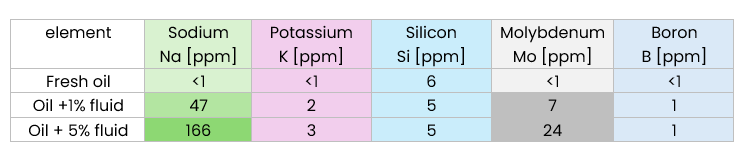
Two samples were blended in a laboratory homogeniser. Fresh amber-coloured oil and coolant were used in quantities of 1% and 5% by weight. A popular oil, widely used in high-power diesel locomotives (mineral oil for medium-speed diesel engines of all types, supercharged, operating at maximum loads across the entire ambient temperature range, API CF classification), and a fluid containing 50% demineralised water and 50% concentrate (based on ethylene glycol with additives in carboxylic acid and molybdate technology).

Table 1 shows the content of elements typical for coolants determined in ICP-OES analysis in samples from the experiment.

The molybdenum contents indicated are lower than the typical additive content in some engine oils, e.g. approximately 50 ppm Mo in popular API CI-grade oils, which shows that in this case molybdenum content is not a reliable indicator of coolant contamination in oil.

The sodium content indicated is unusual for engine oils. The content, as in the experiment, in used oil indicates that corrective action is necessary.

The infrared spectrum shows distinct, intense absorption bands associated with the presence of coolant in the oil sample. A broad band associated with the -OH hydroxyl group in the wave number range >3000 cm⁻¹ and a doublet of peaks in the wave number range 1000–1100 cm⁻¹, referring to the C-O and C-C-O functional groups, are characteristic.

In a similar experiment, using a coolant based on ethylene glycol but containing anti-corrosion additives in a different technology (silicates), identical changes in the infrared spectrum were observed. This indicates that the coolant technology does not affect the analysed spectrum in practice.

A frequently asked question is how stable an oil-coolant emulsion is. In order to find the answer, an oil emulsion (mineral base, API CB classification) was blended with ethylene glycol (50/50). It took seven months for complete separation to occur – until the oil returned to a clear, amber colour. After this time, no coolant was found in the oil phase in elemental testing or infrared spectrum analysis.

Testing engine oils from diesel locomotives is a very important tool in a proactive rolling stock maintenance strategy. We estimate that among the group of diesel locomotive engine oil samples that are problematic in some way (requiring action), oils contaminated with coolant account for approximately 20% of the group. Signs of coolant contamination in oil are not always obvious in laboratory test results, even when using the most advanced testing techniques, as they do not always show the expected correlation. The diagnostician’s experience is therefore essential for the correct interpretation of the results.

contact

Do you have questions about oil contamination with coolant?

contact our specialist or the laboratory diagnostic team:

Brak połączenia z internetem

Nie udało się nawiązać połączenia z siecią. Upewnij się, że masz dostęp do internetu, a następnie odśwież stronę, aby kontynuować korzystanie z serwisu.